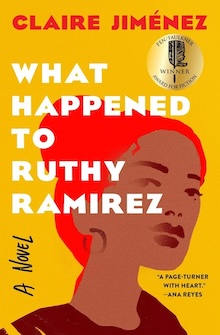
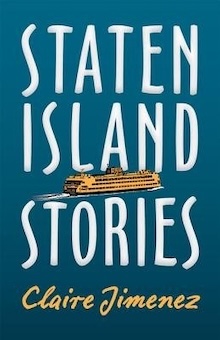
Claire Jiménez is the author of two full-length works of fiction, the short story collection Staten Island Stories (John Hopkins University Press, 2019), the novel What Happened to Ruthy Ramirez (Grand Central Publishing, 2023). Staten Island Stories features twelve short stories which follow the lives of Staten Islanders living in hostile environments and economically uncomfortable circumstances. From children shooed away from loitering at the ferry terminal, to teachers in over their heads, or young women seeking to escape their debt collectors or their own addictions, to passengers during the 2003 Staten Island Ferry crash, Jiménez’s characters find themselves stuck in places they’d rather not be. Wandering an unfamiliar neighborhood in search of a high school reunion, only to find it right before a shooter interrupts the festivities; in a home they’ve scrimped to purchase only to discover its strange haunting qualities; offered a job interview only to find themselves evicted from the bus on their way to the venue, Jiménez’s characters are victimized and/or trapped by their circumstances. Staten Island Stories brings attention to a borough rarely depicted, expanding depictions of New York City, which frequently overlook Staten Island, and which have been largely focused on Brooklyn, Manhattan, Queens, and The Bronx. Also set in Staten Island, Jiménez’s novel What Happened to Ruthy Ramirez focuses on the disappearance of thirteen-year-old Ruthy Ramirez, who leaves school one afternoon and never makes it home. As the title suggests, the novel’s central concern is learning what happened to her: Was she abducted, killed, or did she run away? Did any of her friends and associates harm her? If she ran away, where did she turn up? Could “Ruby,” a woman on reality TV show Catfight, be Ruthy all grown up now?
The novel also asks what happens to everyone in the Ramirez family, from the father who is falsely accused of having something to do with her disappearance, to her mother and two sisters whose life choices are responses to her disappearance. Told from alternating points of view, beginning with Ruthy’s mother and sisters and later including Ruthy herself, readers are not only afforded a chance to see the way Ruthy’s disappearance impacts her family and reshapes those who love her, but also the ways in which the strivings of Latina women are met with various obstacles, from Ruthy’s eldest sister who works as a CNA being rewarded for her hard work and efficiency with more duties and grisly tasks while her less efficient coworkers are cut more and more slack, to Ruthy’s younger sister who leaves for college at a prestigious institution and a difficult major only to find herself working retail. What Happened to Ruthy Ramirez depicts what happens when women of color are deemed too much—too loud, too argumentative, too willing to fight back—and their tenderness can’t be seen beneath their toughness.
Amina Gautier spoke with Claire Jiménez about her short story collection and her novel.
+
AG: Staten Island is often treated as the forgotten borough and many of the characters in your collection and novel deal with being overlooked. In both, you write about characters struggling to be seen, several of whom become unexpected heroes. What are you hoping for, in terms of character complexity, when you craft your characters for short stories? How is that process different when developing characters for the novel?
CJ: As I’m writing, I’m always trying to find something interesting that stands out about the character and makes them feel real. Typically, this means putting the character in scene. I want to see how they react in certain situations. What are they always saying? What will they never say aloud? When and where do they contradict themselves? Both short stories and novels require this type of character work. But with a novel you also must consider how to sustain the momentum of the narrative voice over hundreds of pages, which of course requires a deep understanding of your character. For What Happened to Ruthy Ramirez, I was developing multiple perspectives. So, as I was creating the characters, I was also thinking about their stories in relation to each other. I was interested in how their voices overlapped and/or when they collided. Where were the gaps? What does one character know that the other doesn’t? How could I use that dissonance to build mystery or suspense?
AG: The characters in Staten Island Stories deal with various illnesses including addiction, depression, and epilepsy, among others. What are the challenges of getting illness on the page?
CJ: In my own fiction, I’m often thinking about how certain types of illnesses are connected to trauma and how that trauma is inherited from colonialism and/or racism. At the same time, I don’t want my characters to sound like case studies or for the symptoms to eclipse their individuality. I think anchoring the illness in the body and describing how it affects the day to day is important. In much of my work, I’m exploring how illness or grief shifts the way a character moves in the world, while also trying to provide space for the characters’ own unique histories.
AG: The ferry is a reoccurring motif in your short story collection, appearing and reappearing in your stories—even when your characters don’t take it and are just chilling at the ferry terminal. Tell me about the importance of the Staten Island ferry in your fiction.
CJ: For a long time, I had a complicated relationship with the ferry, primarily because I was always missing it. Missing the boat means you’ll be a half hour late for work. So, I would curse that ferry every time I missed it. At the same time, I’ve written so many stories on the boat. It’s a great space to watch and study people. And the ferry is an important part of many Staten Islanders’ lives. On any given morning you can witness a crowd of Staten Islanders running for dear life through the terminal to catch that boat. I’m always fascinated by that image of hundreds of people with vastly different experiences and lives running at the same time.
AG: I have to confess that whenever I think of your novel’s title, I imagine it with a question mark, which is wrong. You could have called the novel What Happened to Ruthy Ramirez?, but instead the title is What Happened to Ruthy Ramirez, which changes the title from a question to an answer. Please talk about what influenced the choice of your novel’s title.
CJ: The original title of the novel was Catfight. Over the years, I had become so attached to that title that at first, I resisted when my agent pressed to change it. I’m grateful I listened to Jane though. Before she was an agent, she was an editor for many years. She pushed back and said this novel is about more than reality TV. We went back and forth for a while before we landed on What Happened to Ruthy Ramirez. And the title slowly grew on me because I realized that as each woman in this family explored what happened to Ruthy, they were also revealing what had happened to them. And I was deeply interested in how Ruthy’s disappearance affected this family.
AG: What inspired the novel? How did Ruthy come to be?
CJ: So much: Reality TV, the stories of missing girls and women in the nineties in New York, intergenerational trauma, and the legacies of colonialism. This novel came to be after years of work, over a decade of drafts. Slowly the themes and the characters came more into focus. But it took years of revision.
AG: This novel is told from multiple points of view. When did you know you would include more than Ruthy’s voice?
CJ: Originally, this was a short story with just Nina’s voice. But as I was turning it into a novel, I knew I had to grow it with multiple perspectives because I wanted to explore how the disappearance affected this family. Ruthy’s perspective came last. I wanted her voice to hang over the rest of the perspectives like a ghost. I also realized I could use her sections to build suspense.
AG: What kind of research did writing the novel involve?
CJ: I spent a lot of time listening to oral histories from the digital archive at the Center for Puerto Rican Studies to develop the mother’s voice. Specifically, I was interested in language patterns and how migration affects the mother’s fears and anxieties for her daughters. I also enjoyed researching the nineties and remembering the music, fashion and obsessions of my childhood: TLC, the golden name plates, the bubble font etc. And I love the archive. I have to be careful though that the research doesn’t eclipse the writing.
AG: What’s the best piece of craft-related writing advice you’ve ever received? How has it helped your development as a writer?
CJ: I’ve learned so much over the years from many writers and professors. While I was studying at the University of Nebraska Lincoln, one of my professors, Kwame Dawes, had me read the manuscript aloud and record it which helped tremendously. I was able to catch when something didn’t work in the voice. It also helped me catch when the momentum was sagging, when I needed more scene or when the character’s voice felt awkward. Most recently, I’ve been thinking a lot about sound. I love poetry and poets! And I think being around them has taught me to pay attention to sound. As the prominent scholar and poet Kamau Brathwaite wrote in History of the Voice, “The poetry, the culture itself, exists not in a dictionary but in the tradition of the spoken word. It is based as much on sound as it is on song. That is to say, the noise that it makes is part of the meaning, and if you ignore the noise (or what you would think of as noise, shall I say) then you lose part of the meaning.”
+++
Claire Jiménez is the author of the short story collection Staten Island Stories, winner of the New York Society Library’s Hornblower Award, and What Happened to Ruthy Ramirez, winner of the Pen/Faulkner Award for Fiction. Jiménez is the co-founder of the Puerto Rican Literature Project. She teaches at the University of South Carolina.
+
Amina Gautier is the author of At-Risk, Now We Will Be Happy, The Loss of All Lost Things, and The Best That You Can Do. For her body of work, she was awarded the Pen/Malamud Award for Excellence in the Short Story.