Red Leap Theatre on adapting the short story “Animal Wife” for the stage—and trusting young audiences with grief
Which stories from childhood stick with you? Artax drowning in the Swamp of Sadness? The Last Unicorn returning to her wild form, leaving the prince behind? David Bowie’s Goblin King luring Sarah into a labyrinth in search of her baby brother?
These are the kinds of stories the artists behind Red Leap Theatre reference as they create work for young audiences: stories that take the anxieties of childhood and adolescence seriously, transform those feelings through art, and linger long past childhood.
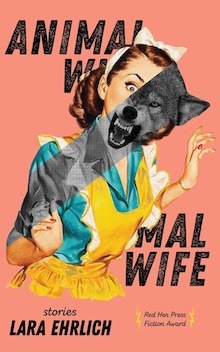
That’s the kind of story I was going for in my collection Animal Wife (Red Hen Press, 2020), which explores women’s transformations: from girls into women, wives, mothers, monsters. Red Leap, a physical-theater company based in New Zealand, adapted the collection’s title story into Cygnet, an all-ages production that premiered in Auckland in September 2026.
In “Animal Wife,” twelve-year-old Alex discovers that her mother has disappeared and believes the story her mother once told her: she had been a swan who removed her feathered cloak to bathe in a pond, only to have a man steal the cloak and make her his wife. He buried it beneath the house he built over the pond. Alex believes that when she finds the hidden cloak and returns it to her mother, her mother transforms into a swan and flies away. As Alex’s father digs up the backyard, eventually uncovering the pond, Alex sets out to reclaim her mother.
I spoke with the directors, Red Leap’s artistic director Ella Becroft and education director Paddy Carroll, about transforming “Animal Wife” into physical theater, what they changed in the process, and how they created a work for young audiences about grief, magic, and letting go.
+
Lara Ehrlich: What was it about “Animal Wife” that made you think, There’s a piece of theater in this?
Ella Becroft: Because our work is very physical and doesn’t use a lot of language, we needed a story with a clear arc that could translate into physical theater, but also an active journey, an interesting environment, and a heightened world. It also needed to be a “suitcase show” we could tour easily.
I was looking specifically at short story collections written from a woman’s perspective, which is how I came across Animal Wife. As a company, we try to choose stories that center women, written by women—and have a lot of women on the creative team.
Paddy Carroll: As a devising physical-theater company, it’s incredibly rich to find a source with both such a strong story and such rich poetics. We wanted to make a show for young people that was mature and interesting, with a strong spine for us to grapple with. The best source material often has more questions than answers.
LE: How did Cygnet start to come together? You had the story—what happened next?
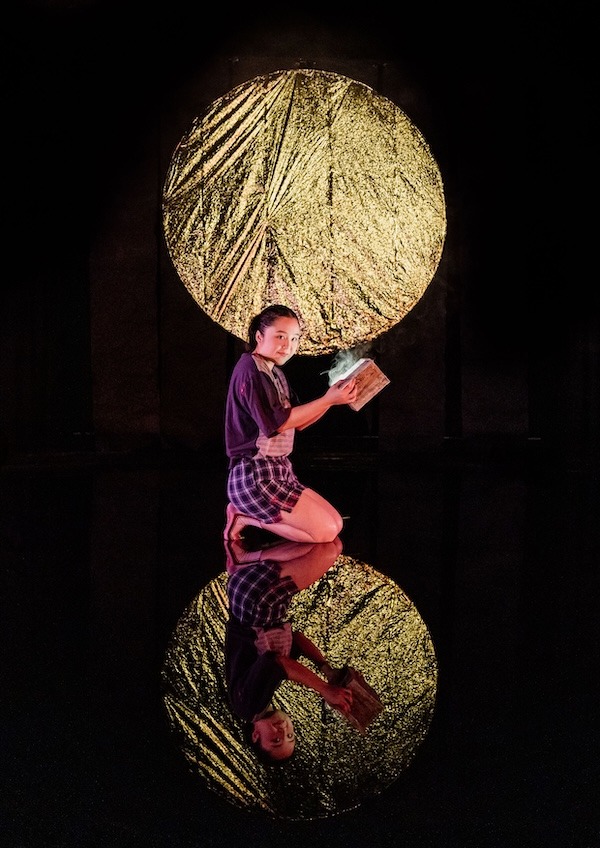
PC: We began with your story as the provocation, and then we brought on the design and creative team. What I love about Red Leap, and about devising when it’s done well, is that every member of the creative team has a say in almost every choice. The typical hierarchies get deconstructed in service of the idea that we all make the work together—we all muscle every choice. We discuss what the text could look like mounted onstage, but we never come in with something that’s 100% fixed. We think, These are the territories we’re going to be interested in. That’s very much how Cygnet was devised.
For example, our set designer, John Verryt, said, “I think water would be a beautiful material to play with.” He also introduced construction materials because Father/Cobb builds the family’s house over the pond. That creative conversation continues almost until we open the show.
We also treat our actors as key creative voices. They’re making big decisions about character and story and following their own hunches and instincts, because they’re not just performing the characters—they’re facilitating the stage magic. Sean MacDonald, who plays Father/Cobb, is an incredible dancer and choreographer. He helped create the feeling of a family that expresses so much love through touch.
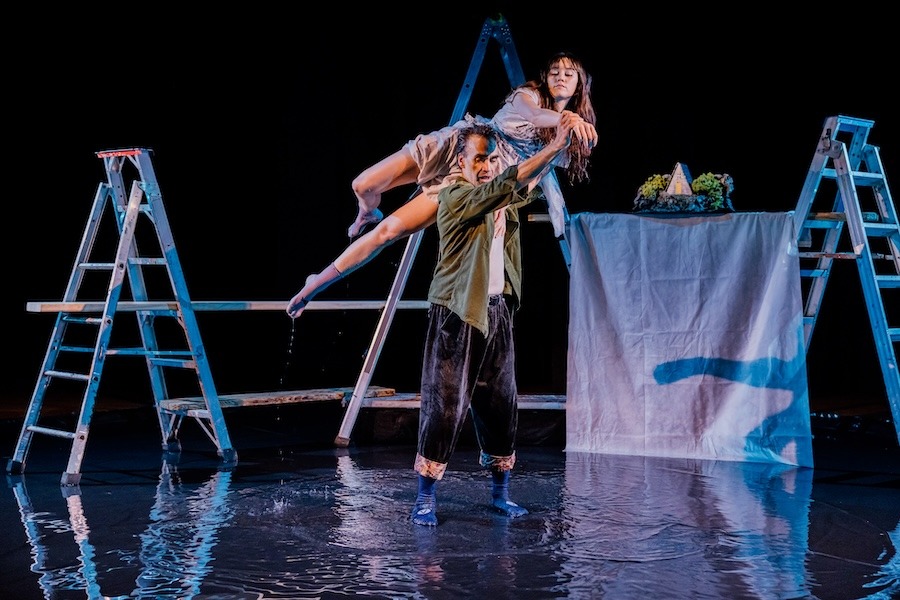
LE: How did the constraint of a three-person cast shape the characters, particularly the decision to cut the character of Amir, the boy around Alex’s age who appears halfway through the original story?
PC: To me, Amir represents Alex experiencing adolescent attraction for the first time, but she also perceives him as a distraction from her journey. The middle section of the story really revolves around their relationship.
EB: I liked the awakening in Alex, and I also liked Amir holding the truth when he tells Alex, “Your mother is not a swan; I saw her get in the car and drive away—wake up.” Alex is on that precipice between childhood and understanding a bit more about the reality of the world, and Amir is already on the other side.
PC: We really wanted to home in on the relationship between the parents and child as the core of the show. I wondered: what if we translate some of the playful nature of Alex and Amir’s relationship into the relationship between father and daughter? We were also conscious that the audience for our work skews younger than the audience for yours.
The other thing, dramaturgically, was that Amir bestows the totemic objects that Alex uses in her descent into the world below the house to find her mother. Throughout the devising process, those objects transformed into gestural symbols between the parents and child—a visual language we return to in the second half of the show. It’s what the bodies do in space that brings those relationships back together and helps Cygnet/Alex through the final part of her journey.
We often follow an actor’s instinct. There was a moment when Ariāna Osborne, who plays Mother, discovered a gesture: she touches fingers with Cygnet/Alex, played by Louise Jiang, and their bodies move as though an electrical current flows between them. We thought: Okay, this gesture has history. It’s something that bonds the family together. The gesture felt magical, and it kept echoing throughout the work.
When we were exploring how to have Cygnet/Alex pull Father/Cobb back from the darkness that consumes him after the mother’s death, I remember Ella going, “Yes, yes, yes—we’ll do it in this moment.”
EB: Because there are no words in the show, we have to find gestures the audience will understand at a gut level, and then we repeat them and give them more meaning. That’s how we build narrative for the audience without words.
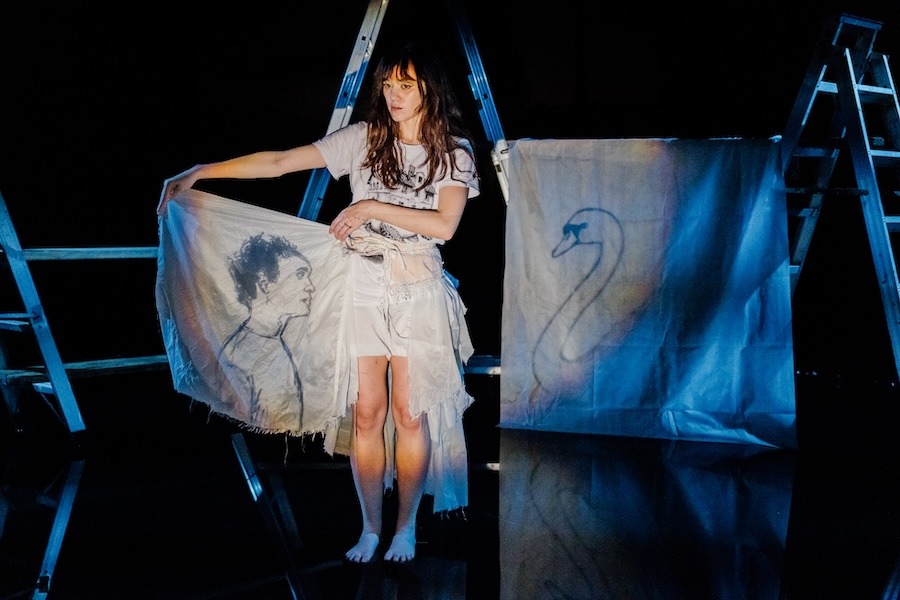
LE: It’s similar in prose. When you’re trying to create a magical-realist feeling on the page, you don’t want to over-explain how the magic works.
PC: We’re not making high fantasy. We’re making magic.
LE: We don’t need to know the rules; we just need to see the magic at work.
You also made an interesting choice regarding the mother’s transformation. In my version—based on the swan-maiden fairy-tale trope—the father comes upon a woman bathing in a pond and steals her feathered cloak so she can’t transform back into a swan. In Cygnet, it’s the mother’s choice to stow away her cloak and live with the father as a woman.
PC: In your story, he’s the deconstructed version of the prince or the woodsman. We knew early on that we wanted to pull back some of those elements and create a father the kids in our audience could relate to.
EB: I really loved that part of your story, how the mother really loved her daughter, but left anyway. That’s the ultimate crime for a mother, to abandon her children. I think having different versions of motherhood in the world is good.
In the stage production, though, Ariāna said, “If Father/Cobb has trapped me, how are we going to find a way, in this simple, wordless form, for the audience to see him as a nuanced character?” Ariāna also needed to find more agency for the mother, so she wasn’t just a ghost in the background.
We were also responding to the relationship developing between Father/Cobb and Cygnet/Alex, which was beautiful and warm and playful. Once we reframed their relationship, we realized we needed to make a call about what had happened to the mother. And we made the call that she had died.
PC: One of the touchstones we found when we were looking at adaptations was the way Studio Ghibli adapts books. Their films are for young people but have a real seriousness to them. They believe in the seriousness of children.
EB: Children’s theater can sometimes lean too heavily into fairy tale and become a bit cutesy. “Animal Wife” had that fairy-tale quality colliding with modernity—with this grunginess. I loved the collision of those two tones.
PC: We spoke a lot about how to honor the source text while also honoring the adaptation. For me, Alex and her father are experiencing intense grief. I brought my own memories of losing close family members as a child into that.
One morning I was driving in and thought, “What if the box—that in the original story held the feathered cloak—contains Mother’s ashes?” Everybody in the room was like, “That would be a massive change.” We talked about it, and when we got to the final moment of the show, we tested it against multiple eyes. When you make choices like that, it feels so spicy and sparky and dangerous.
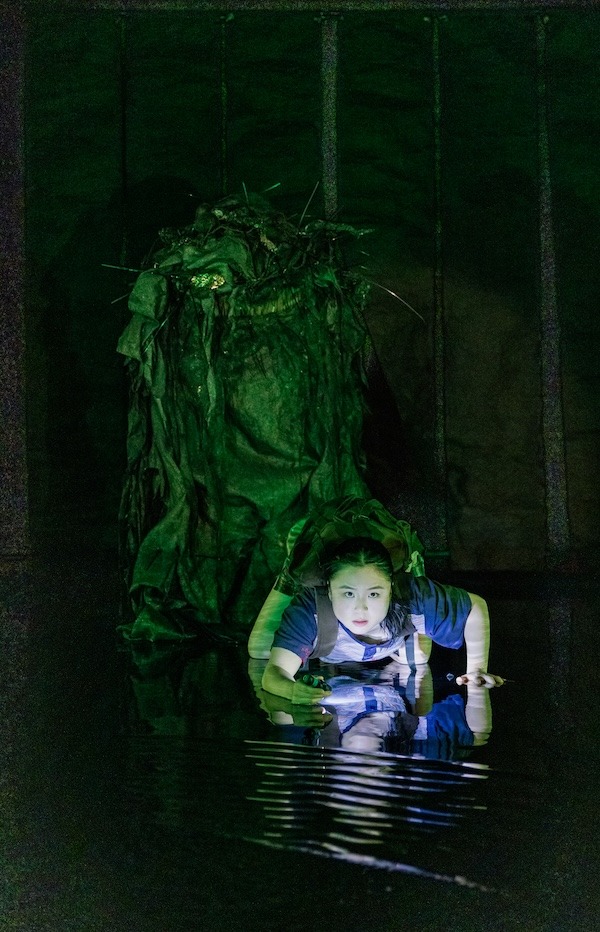
LE: The moment when Cygnet/Alex turns over the box and the mother’s ashes pour out broke my heart in the best possible way. It is such a beautiful, powerful moment. I also love that you don’t spell it out for the audience; you preserve that ambiguity. An audience member might understand that she has died, or they might choose to hold on to the magic with Cygnet/Alex.
EB: It works because the youngest audience members don’t understand the reference to the ashes, so they see something different than the older members of the audience.
PC: In the poetics of it, a young person can still see the fantasy version of the story alongside the other version. That was something incredible about the original story that we wanted to uphold in our adaptation. I read an interview with you where you said it doesn’t matter whether Mother is a swan; what matters is that Alex believes she is. That idea—that both realities can exist simultaneously for an audience member—felt very important to the work.
EB: It’s such a universal thing for a child, grappling with the moment when you learn that your parents will die. I remember learning that, and I remember with both of my kids that moment when it suddenly clicked. It’s terrifying.
PC: This is sort of Easter-eggy, but when we made the decision about the ashes, we talked about the idea that in that final moment, Cygnet/Alex could be much older; many years could have passed before that moment occurs.
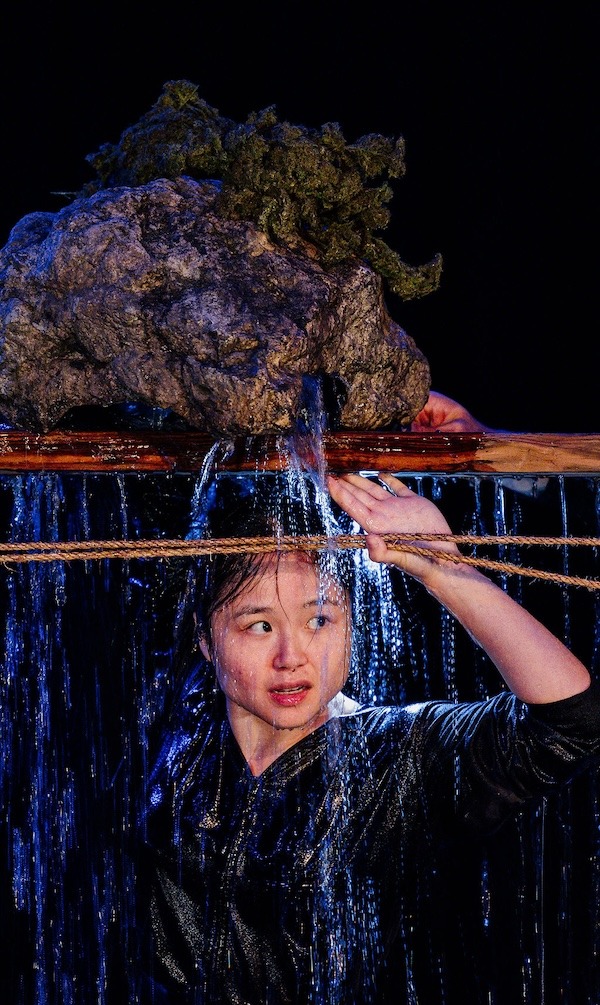
LE: The journeys of all three characters were so clear, even as you left room for interpretation and magic. I thought removing Amir clarified the arc of the core family and lent power to the grief and acceptance at the end—whether it’s acceptance of the mother’s death, disappearance, or transformation. How have audiences responded?
PC: We did six shows and showed it to every age bracket we thought the work would speak to. It was incredible to feel the stillness and rapt attention of young kids. The actors could hear these little moments of them saying things out loud. Louise heard one child say, “The mother’s a swan!” At the end, others were saying, “Oh, she’s dead.” They were engaging with the show from beginning to end, which was a huge delight.
One of the things we wanted was for young people to experience the kind of emotional journey we felt watching stories like The NeverEnding Story—those films for young people with huge emotional stakes that were wondrous and scary at the same time. People have asked us whether the show is too scary, and we’ve said, “We don’t think so.”
EB: When you think back to the stories you experienced as a kid, the ones that really stay with you are the ones where you’re like, “I wept. The Lion King destroyed me.” And because of that, it’s in your heart. I think story is a beautiful container for big emotions.
There’s a question around content warnings and concern about young people who may have lost a parent. You don’t want to traumatize someone. Cygnet is a real weeper, but it doesn’t feel like we’re stabbing the audience in the heart and then leaving them to bleed out on the ground. It feels warmly held. Most adults are crying at the end, but someone came up afterward and said, “It’s like a big, sad, warm hug,” which feels about right.
PC: Jessica Chambers’ musical score carries that as well. She created a five-and-a-half-minute track that takes us through the emotional high of the ending and then through a steady series of releases into the darkness of the final beat.
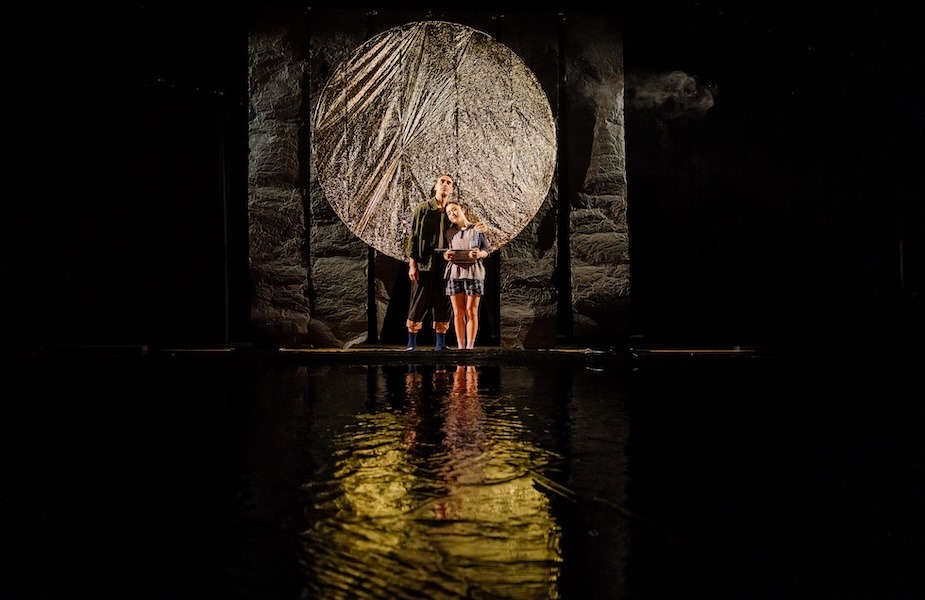
LE: What’s next for the play?
EB: Cygnet is the project for next year. We’re pitching it to festivals, mostly in Asia, where we already have quite a big audience, and we want to bring it into school theaters. We work in schools around the world with artists who may not otherwise have access to contemporary theater. That’s part of why we wanted the show to have a small cast and be super nimble.
PC: We also teach alongside the show about how and why we made it the way we did. We want the work to be accessible not only to audiences, but to young theater-makers who can engage with the practices behind Cygnet. That’s one reason we committed to making parts of the show as lo-fi as they are: you can create something this magical with simple structures in your own theater-making context.
EB: You don’t need an incredible projector and a huge budget. You can use a torch and a little feather you found in your pillow and make something incredible.
LE: The spareness works with the story. Cygnet/Alex is creating this fantasy world around herself, so it shouldn’t feel highly produced. It feels makeshift, created from her own materials and references.
PC: One of my favorite things about your story is that it’s so poetically dense. And it’s the opening story of a collection dedicated to your own child. We feel incredibly fortunate to have been able to adapt it—and then there was the nail-biting moment of showing it to you.
To feel that your response echoes what we’ve heard from audiences gives us great pride in the work, and great respect for you as a member of the creative team on a different continent, on the other side of the world.
+++
Ko Paddy Carroll aho / My name is Paddy. I’ve worked in the performing arts in Aotearoa New Zealand since 2010, in a range of rich and transformative roles. The creation of live work that invite mutual investment from audience and artist both is my passion. To create spaces and experiences where theatre is created, seen and celebrated.
+
Lara Ehrlich is the author of Animal Wife (Red Hen Press, 2020) and Bind Me Tighter Still (Red Hen Press, 2025). Her writing explores girlhood, motherhood, desire, and the intersections of the domestic and the uncanny. She is a Visiting Assistant Professor of English and Writer in Residence at Connecticut College, and is the founder of Thought Fox Writers Den and the creator and host of Writer Mother Monster, a literary podcast exploring the intersections of writing and motherhood. www.LaraEhrlich.com
+